Offshore Hiring Singapore: How to Hire Offshore Teams with an EOR (2026 Guide)
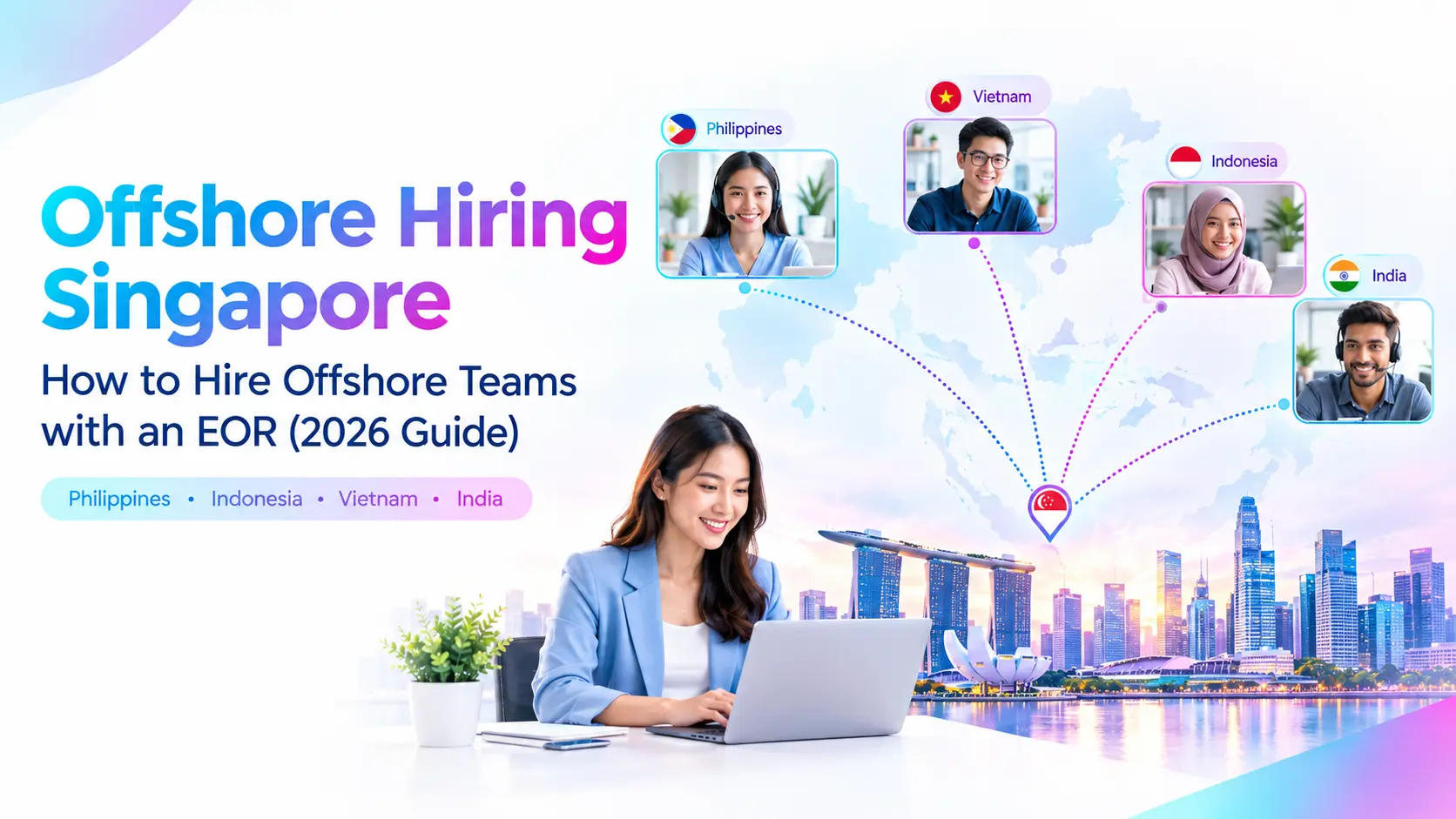
Offshore hiring Singapore means a Singapore company employing skilled professionals who live and work in another country, such as the Philippines, Indonesia, Vietnam or India. Through an Employer of Record (EOR), the EOR acts as the legal employer in that country and handles contracts, payroll, tax and compliance. You manage the daily work and hire without setting up a local entity.
Quick answers- What is it? Hiring employees outside Singapore, usually remote, as your own dedicated team.
- Who is the legal employer? The EOR, through its legal presence in the employee's country.
- Who manages the work? You do: tasks, performance and culture.
- Do I need a local entity? No, not when you hire through an EOR.
- Biggest risk? Applying Singapore rules to overseas staff instead of local law.
This guide covers people who live and work outside Singapore. Employing foreign nationals inside Singapore (work passes) follows different rules; check the Ministry of Manpower (MOM).
Offshore Hiring Singapore at a Glance
| Question | Short answer |
|---|---|
| Common destinations | Philippines, Indonesia, Vietnam, India |
| Typical roles | Software, finance, customer support, marketing, HR and admin |
| Legal employer | EOR (local entity in the employee's country) |
| Governing employment law | The country where the employee works, not Singapore |
| Main cost items | Salary, mandatory local benefits, EOR fee, equipment |
| Best for | Growing teams that want control without a foreign entity |
| Not ideal for | Roles that must be performed in Singapore |
What Is Offshore Hiring?
Offshore hiring is employing people outside your home country. They work remotely or inside a distributed team, and they are your employees, not a vendor's.
They follow your processes, report to your managers and work toward your goals. This is the main difference from outsourcing.
Common offshore roles:
- Software development and IT support
- Finance, accounting and bookkeeping
- Customer service and technical support
- Digital marketing, design and content
- HR operations and recruitment support
- Administrative and operations support
Why Singapore Companies Hire Offshore Employees
Singapore is a strong business hub, but local hiring can be slow and costly for technical and back-office roles. These are the main reasons companies hire offshore employees:
| Reason | What it means in practice |
|---|---|
| Wider talent pool | Access to several large labour markets, not only Singapore's |
| Lower cost base | Salary and office costs are generally lower; the gap depends on role, seniority and country |
| Faster team building | No wait for entity registration before the first hire |
| Flexible scaling | Add or reduce headcount as projects change, within local law |
| Remote-ready culture | Remote and hybrid work is now widely accepted by employers and candidates |
Benchmark each role before you set a budget. Savings are never the same across roles or countries.
Offshore Hiring vs Outsourcing: Which Model Fits?
Offshore hiring through an EOR gives you dedicated employees. Outsourcing gives you a service delivered by a vendor. The right model depends on how much control you need.
| Offshore hiring via EOR | Outsourcing / BPO | Independent contractor | Own local entity | |
|---|---|---|---|---|
| Legal employer | The EOR | The vendor | None (self-employed) | You |
| Control over daily work | High | Limited | Medium | High |
| Dedicated team | Yes | Usually shared | Individual only | Yes |
| Setup time | Short | Short | Very short | Longest |
| Misclassification risk | Low | Low | Higher | Low |
| Best for | Growing teams that want control without an entity | Defined, repeatable processes | Short, specific projects | Large, long-term operations |
How to Hire Offshore Employees from Singapore: 5 Steps
- Define the role and country. Set the skills, working hours and the best market for that talent.
- Choose an EOR with local presence. Confirm it employs through a legal entity in the hiring country and can explain how it handles compliance.
- Find your candidate. Use your own sourcing or recruitment support.
- Sign a compliant local contract. It should cover probation, notice, leave and mandatory benefits under local law.
- Onboard and manage. The EOR runs payroll, statutory contributions and HR admin. You manage tasks, performance and culture.
Offshore Hiring Through an EOR: What the EOR Does and What You Do
An EOR splits responsibility clearly. This is what makes the model safer than hiring contractors informally.
| Responsibility | EOR | You |
|---|---|---|
| Local employment contract | Yes | Approve role and terms |
| Payroll, tax and statutory contributions | Yes | No |
| Benefits and leave administration | Yes | Agree budget |
| Daily tasks and performance | No | Yes |
| Equipment and tools | Depends on provider | Often yes |
| Confidentiality and IP terms | Included in contract | Set requirements |
| Termination process | Runs the legal steps | Makes the business decision |
How to Choose the Right EOR for Offshore Hiring
Choose an EOR that employs staff through its own legal entity in each hiring country, explains local compliance clearly, quotes fees in writing and can show how it handles payroll, termination and data protection. Ask these questions before you sign.
| What to check | Why it matters | Question to ask |
|---|---|---|
| Legal entity in the country | An EOR with its own entity controls compliance directly, instead of passing work to partners | Do you employ through your own entity in each country? |
| Local compliance knowledge | Each country has different mandatory benefits and contract rules | How do you stay current with labour law changes? |
| Contract quality | Contracts must follow local law and protect your IP | Can I see a sample employment contract? |
| Pricing transparency | Hidden fees make budgets unreliable | What is included in the monthly fee, and what costs extra? |
| Payroll and tax handling | Errors can cause penalties for you and your employee | Who files statutory contributions, and how do you report to me? |
| Termination process | Local notice and severance rules differ | How do you manage notice periods and exit costs? |
| Data protection | Offshore staff may handle personal data | How do you protect employee and company data? |
| Support and response time | Issues with payroll or contracts need quick answers | Who is my contact, and what are your response times? |
| Country coverage | You may add new countries later | Which countries do you cover today? |
Red Flags to Avoid
- No clear answer on which entity employs your staff
- Fees that are vague or change after signing
- Refusal to share a sample contract
- Promises of "no compliance risk" with no explanation
- No named contact for support
Quick Checklist Before You Sign
- You know which legal entity employs each person.
- You have a written fee quote with all costs listed.
- You have reviewed a sample contract for probation, notice and IP terms.
- You know how payroll, tax and benefits are handled.
- You know the exit process and who pays for it.
- You have a support contact and a response time.
Offshore Hiring Philippines, Indonesia, Vietnam and India
Each country suits different roles. Time zones also affect how well the team overlaps with Singapore hours.
| Country | Typical strengths | Time difference from Singapore |
|---|---|---|
| Philippines | Customer support, finance, HR and admin; strong English | Same time zone |
| Indonesia | Operations, digital marketing, design, emerging tech | 1 hour behind (Jakarta) |
| Vietnam | Software development and engineering | 1 hour behind |
| India | Technology, finance, analytics, round-the-clock support | 2.5 hours behind |
Mandatory Costs and Compliance by Country
The most common mistake is treating an offshore employee like a Singapore employee. Singapore's Employment Act applies to work done in Singapore. Overseas staff fall under local law.
| Country | Examples to plan for |
|---|---|
| Philippines | Mandatory 13th month pay; government social contributions |
| Indonesia | Mandatory religious holiday allowance (THR); social security contributions |
| Vietnam | Compulsory social, health and unemployment insurance |
| India | Provident fund (EPF); employee state insurance where applicable; gratuity after the qualifying service period |
These are examples, not a full list. Rates, thresholds and rules change, so confirm current requirements with your EOR or local counsel. Notice periods, probation limits and termination procedures also differ by country.
What Does It Cost to Build an Offshore Team Singapore Companies Can Plan For?
Total cost is more than salary. Budget for every line below before you compare it with a local hire.
| Cost item | Notes |
|---|---|
| Gross salary | Varies by role, seniority and country; benchmark each role |
| Mandatory employer contributions | Differ by country (see the table above) |
| 13th month or holiday allowance | Mandatory in some countries |
| EOR service fee | Usually a monthly fee per employee; ask for a written quote |
| Equipment and software | Laptop, licences, security tools |
| Management time | Onboarding, check-ins and training |
Key Risks of Offshore Hiring and How to Manage Them
| Risk | What it means | How to manage it |
|---|---|---|
| Tax and permanent establishment (PE) | Staff abroad may, in some cases, create a taxable presence for your Singapore company | Get tax advice before scaling a team in one country |
| Misclassification | Treating a full-time worker as a contractor can bring penalties and back payments | Use a local employment contract through an EOR |
| Data protection | Offshore staff may handle personal data | Check Singapore's PDPA and local laws, such as the Philippines Data Privacy Act, Indonesia's PDP Law, Vietnam's personal data decree and India's DPDP Act |
| Intellectual property | Work product must belong to your company | Use IP assignment and confidentiality terms valid under local law |
| Culture and management | Distance can weaken accountability | Set clear goals, overlapping hours, documented processes and regular check-ins |
When Offshore Hiring May Not Be the Right Fit
Offshore hiring works best for remote roles with measurable output. It may not suit these cases:
- Roles that must be performed in Singapore
- Work involving highly sensitive or regulated data
- Very large, permanent teams where your own entity becomes more economical
If you are unsure, start with a pilot of one or two roles.
About This Guide
This guide was written and last updated on 21 October 2026 by the Solvix Asia team.
Solvix Asia supports Singapore businesses with offshore hiring in the Philippines, Indonesia, Vietnam and India.
This article is general information, not legal or tax advice. Confirm requirements with qualified advisers in each country.
How Solvix Asia Supports Offshore Hiring Through an EOR
Our Employer of Record services cover local employment contracts, payroll, statutory compliance and ongoing HR support. You keep control of the work. We handle the employment administration.
Frequently Asked Questions About Offshore Hiring Singapore
What is offshore hiring?
Offshore hiring is employing professionals who live and work outside your own country, usually remotely. For a Singapore company, this often means hiring in the Philippines, Indonesia, Vietnam or India.
Why is offshore hiring popular in Singapore?
Singapore companies face high salary costs, a limited local talent pool and long recruitment cycles. Offshore hiring gives access to larger talent pools at lower cost, and remote work is now widely accepted.
How does an EOR simplify offshore hiring?
An EOR is the legal employer of your overseas staff. It issues local contracts, runs payroll, pays taxes and statutory contributions, and keeps the arrangement compliant. You manage daily work and performance.
How do I hire offshore employees from Singapore?
Define the role and country, choose an EOR with local presence, find your candidate, sign a compliant local contract, then onboard. The EOR handles payroll and compliance from day one.
What is the difference between offshore hiring and outsourcing?
With outsourcing, a vendor employs the people and delivers a service. With offshore hiring through an EOR, the people are your dedicated team members. You control their work and culture, and the EOR handles employment compliance.
What are the best offshore hiring destinations for Singapore companies?
The Philippines suits support, finance and admin roles. Indonesia suits operations and digital roles. Vietnam is strong in software and engineering. India offers deep technology, finance and analytics talent.
Is offshore hiring legal for Singapore companies?
Yes, when it follows the employment, tax and data laws of the country where the employee works. An EOR is one common way to do this without a local entity. Get local advice for your case.
Do I need a local entity to hire offshore employees?
No, not when you hire through an EOR. The EOR employs the person through its own legal presence in that country.
How long does it take to hire through an EOR?
Timelines vary by country and role. An EOR avoids the months needed to register an entity. Ask your provider for a realistic timeline for your market.